

Your Home Has No Ductwork — Here Are Your Best AC Options
Adding air conditioning to a house without ductwork is entirely possible, and for most Central Florida homeowners, the answer comes down to one clear winner: a ductless mini-split system.
Here’s a quick look at your main options:
| System Type | Best For | Avg. Installed Cost |
|---|---|---|
| Ductless Mini-Split | Whole-home zoned comfort, older homes | $4,000 – $8,000 |
| Multi-Zone Mini-Split | Multiple rooms, no ductwork needed | $8,000 – $12,000 |
| High-Velocity Mini-Duct | Homes with tight hidden spaces | $5,000 – $15,000 |
| Through-the-Wall / Window Unit | Single rooms, budget installs | $1,500 – $5,000 |
Most homeowners in older Florida homes — built long before central air was standard — are left choosing between sweating through summer or cobbling together window units and space heaters. Neither option is comfortable, efficient, or built to last in Florida’s brutal heat.
The good news? Modern ductless technology has changed everything. You can now get whole-home comfort, room-by-room control, and serious energy savings — without tearing open a single wall to run ductwork.
I’m Yanelis Roman, owner of ROMAN Air Cooling and Heating, and I’ve helped countless Florida homeowners find the right path to comfortable, efficient cooling when adding air conditioning to a house without ductwork seemed overwhelming. In this guide, I’ll walk you through everything you need to know to make a confident decision.
Ductless Mini-Splits: The Premier Solution for Homes Without Ductwork
When we talk about adding air conditioning to a house without ductwork, the conversation almost always starts and ends with ductless mini-split systems. These systems have moved well past being a “niche product” and are now the global standard for efficient, non-invasive climate control.
In Central Florida, many of our charming historic homes in places like Saint Cloud or Kissimmee weren’t built with the massive overhead space required for bulky metal ducts. For these properties, a mini-split is a lifesaver. Unlike a traditional central AC system that forces air through a labyrinth of dusty, leaky ducts, a mini-split delivers conditioned air directly into the room where the unit is mounted.
Why Mini-Splits Are Ideal for Ductless Homes
The primary reason we recommend these systems is their versatility. You aren’t limited to one “look.” Depending on your home’s layout and your personal style, you can choose from:
- Wall-Mounted Units: The most common and cost-effective option, mounted high on a wall to stay out of the way.
- Ceiling Cassettes: These sit flush with your ceiling, making them nearly invisible—perfect for a sleek, modern look.
- Floor-Standing Units: Ideal for rooms with low windows or slanted ceilings where wall space is at a premium.
When comparing mini-split AC vs traditional systems, the biggest difference is the lack of “duct loss.” Traditional ducted systems can lose up to 30% of their cooling power through leaks and poor insulation in the ductwork. By eliminating the ducts, you ensure that 100% of the air you pay to cool actually reaches your living space.
Benefits of Adding Air Conditioning to a House Without Ductwork via Mini-Splits
If you’re tired of the “thermostat wars” in your house, you’re going to love the zoned comfort of a mini-split. Each indoor unit operates on its own thermostat. This means you can keep your bedroom at a crisp 68°F for sleeping while leaving the guest room or kitchen at 75°F to save money.
Here are the heavy-hitting benefits:
- Energy Savings: Homeowners who switch to ductless mini-split systems often see their energy bills drop by 30% or more compared to using window units.
- Whisper-Quiet Operation: While a window unit might roar at 60 decibels, a high-quality indoor mini-split unit operates as quietly as 19 to 32 decibels. That’s quieter than a library! Even the outdoor units are impressively quiet, often running at just 46 decibels—about the level of a normal conversation.
- Inverter Technology: Think of standard AC like a light switch (either all the way on or all the way off). Inverter technology is like a dimmer switch. It allows the compressor to speed up or slow down precisely to meet the cooling demand, preventing the loud, energy-sucking “surges” of traditional units.
The Mechanics of Ductless Comfort
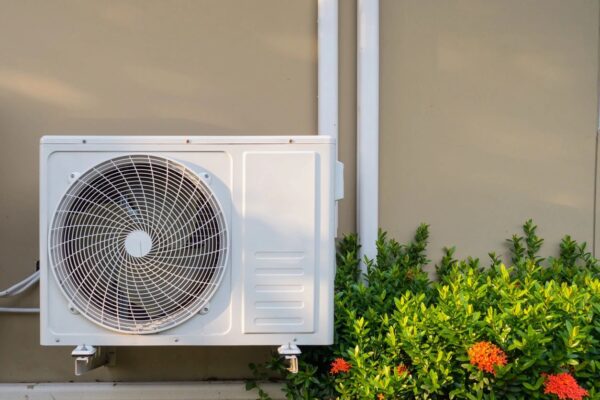
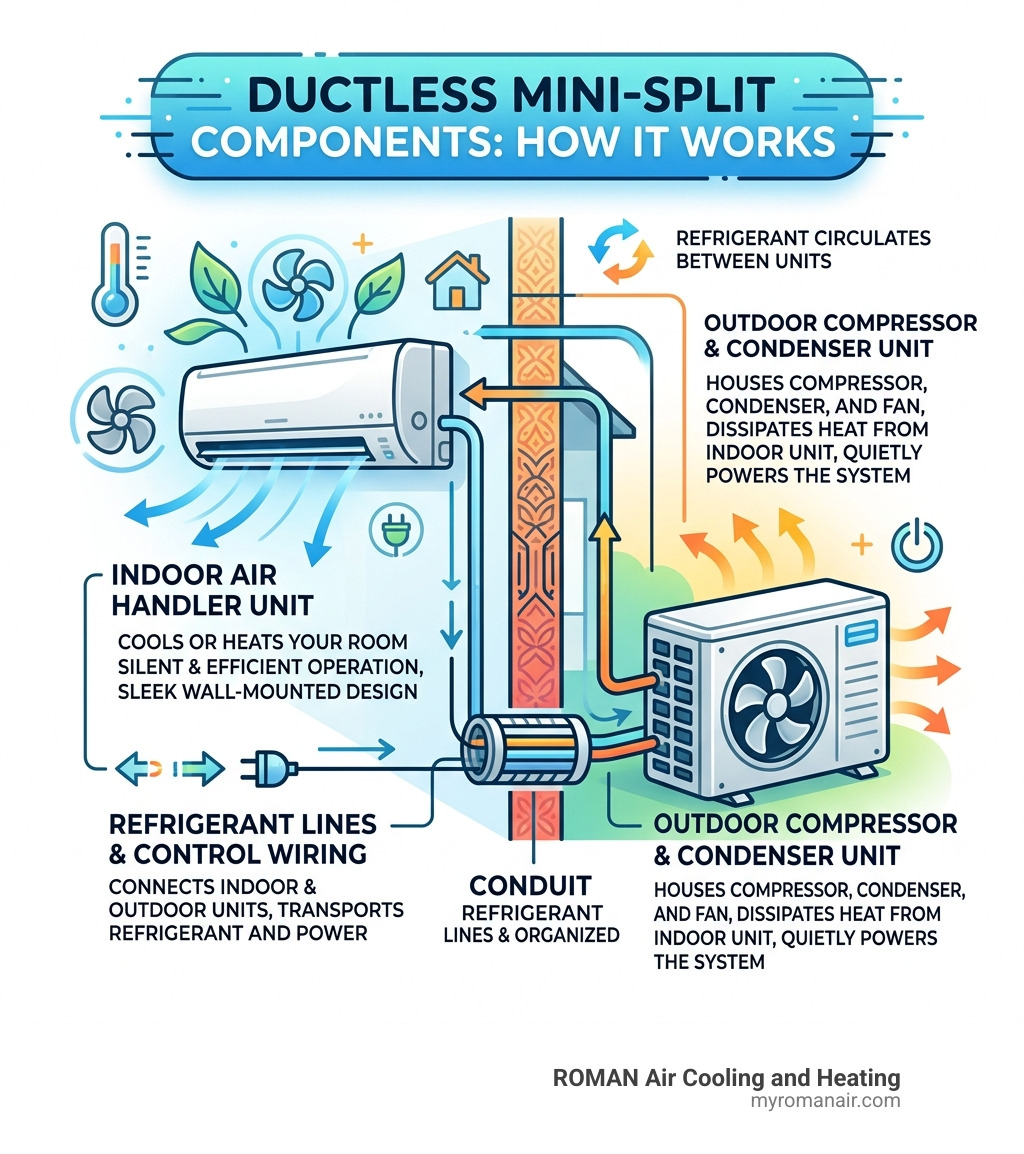
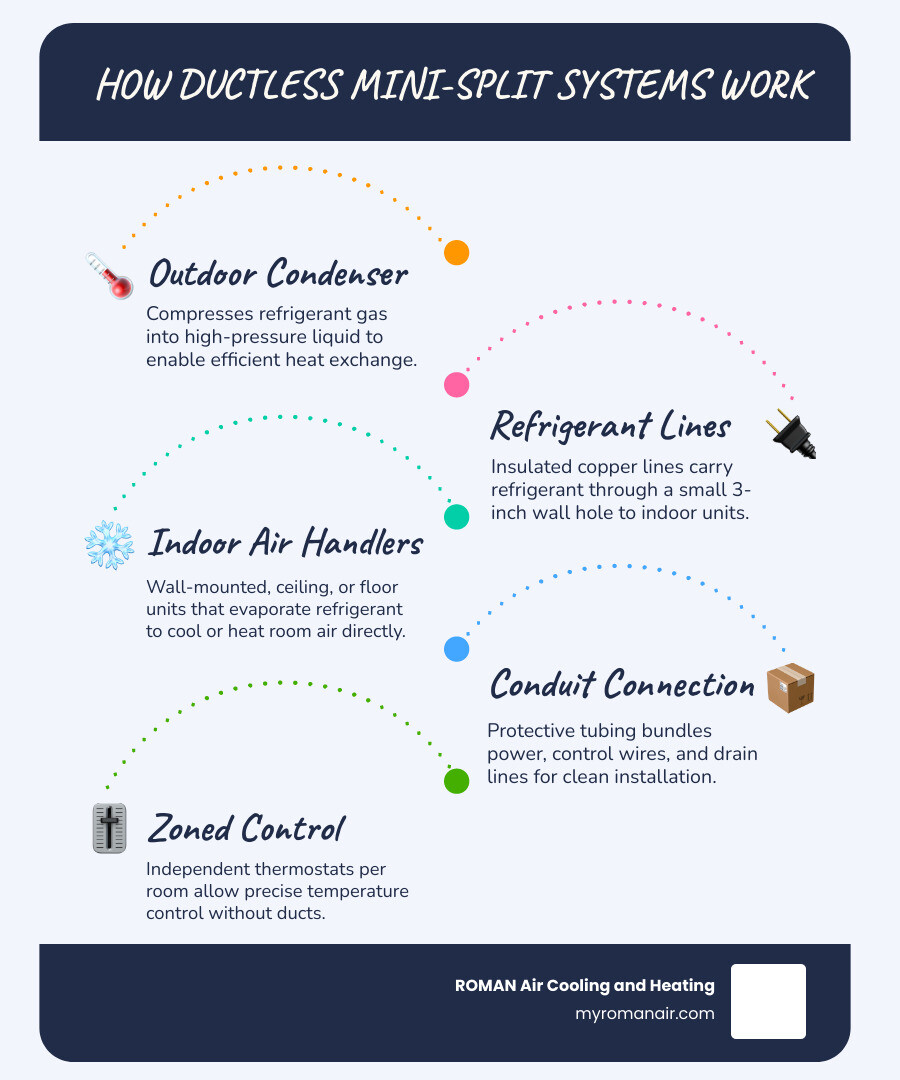
Understanding how these systems work helps demystify the installation process. A ductless system is comprised of two main parts: an outdoor compressor/condenser and one or more indoor air handlers.
Instead of massive ducts, these two components are connected by a “line set.” This is a small bundle containing refrigerant lines, electrical wiring, and a condensate drain line. To connect them, we only need to drill a small, 3-inch hole in your exterior wall. This minimal footprint is one of the reasons why mini-split systems work well in older Florida homes where preserving the structural integrity of the walls is a priority.
The refrigerant circulates between the units, absorbing heat from inside your home and pumping it outdoors. Because the noisy compressor stays outside, your indoor experience remains peaceful and cool.
Considerations for Adding Air Conditioning to a House Without Ductwork
While we love these systems, we always want our customers in Lake Nona and Orlando to have the full picture. There are a few things to consider before pulling the trigger:
- Upfront Costs: The initial cost of a ductless system is typically about 30% higher than a traditional central air unit (if you already had ducts). However, if you have to install new ductwork from scratch, that can easily cost $10,000 or more, making the mini-split the much more affordable choice overall.
- Aesthetic Integration: You will have a unit visible on your wall or ceiling. Fortunately, modern designs are very sleek, and we offer many mini-split AC space-saving solutions to help them blend into your decor.
- Professional Installation is Key: This is not a DIY project. To ensure the system operates at peak efficiency and to protect your warranty, you need a licensed professional. We perform a Manual J load calculation for every install. This is a scientific way of measuring your home’s square footage, insulation levels, and window placement to ensure the system is sized perfectly. An oversized unit will “short cycle,” failing to remove humidity (a disaster in Central Florida!), while an undersized unit will run constantly and drive up your bills.
Year-Round Performance: Heating and Cooling
One of the best-kept secrets of ductless systems is that they aren’t just for cooling. Most modern mini-splits are actually heat pumps.
In the summer, they pull heat out of your house. In our (admittedly brief) Florida winters, they reverse the process, extracting heat from the outdoor air and moving it inside. Even when the temperature drops, these systems remain incredibly efficient.
When shopping, look for the SEER2 (Seasonal Energy Efficiency Ratio) and HSPF2 (Heating Seasonal Performance Factor) ratings. Higher numbers mean better efficiency. Many of the systems we install offer comfort solutions with a ductless mini-split that can handle everything from a humid July afternoon in Davenport to a chilly January morning in Celebration.
Installation and Maintenance for Peak Performance
The installation process for adding air conditioning to a house without ductwork is remarkably fast compared to traditional retrofitting. While installing new ducts can take a week of construction and drywall repair, a multi-zone mini-split can often be installed in just one to two days.
What to Expect During Installation
First, we conduct a site survey to determine the best placement for the indoor units to ensure even airflow. We then mount the units, drill the 3-inch access holes, and connect the line sets to the outdoor condenser. We also handle the electrical requirements, ensuring your home’s panel can support the new system. Finally, we set up the condensate drainage to ensure the water removed from your humid Florida air is safely piped away from your foundation.
For more expert advice on ductless systems, the quality of the installation is just as important as the brand of the equipment.
Maintenance Tips for Longevity
To keep your system running for its expected 15 to 20-year lifespan, you need to be proactive:
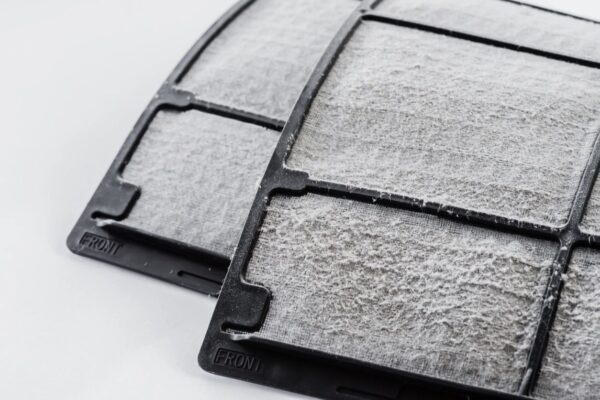
- Clean the Filters: This is the most important step. You should check and clean the indoor unit filters every 2-4 weeks. It’s as simple as popping the cover, rinsing the plastic mesh, and letting it dry.
- Keep the Outdoor Unit Clear: Ensure there is at least two feet of clearance around your outdoor condenser. Trim back any Florida brush or weeds that might choke the airflow.
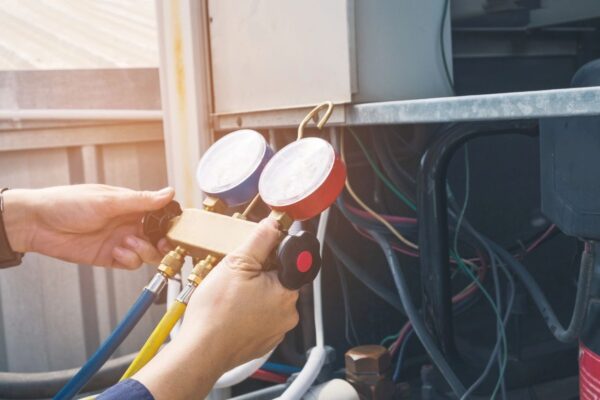
- Annual Professional Tune-ups: Once a year, have us come out to deep-clean the coils, check refrigerant levels, and ensure the electrical connections are tight. A well-maintained mini-split loses less than 5% efficiency over its lifetime, whereas a neglected ducted system can lose up to 40%.
Frequently Asked Questions about Ductless AC
Is adding air conditioning to a house without ductwork more expensive than traditional central air?
If your home already has ducts in good condition, central air is usually cheaper upfront. However, if you are starting from scratch, adding air conditioning to a house without ductwork via a mini-split is almost always the more cost-effective route. You avoid the $10,000+ expense of duct installation and the mess of a major home renovation.
Can a ductless system heat my home during the winter?
Yes! Most ductless systems are heat pumps. They are far more efficient than electric baseboard heaters or space heaters. In fact, they can save you 30% or more on your heating bills during those cool Florida nights in Harmony or Poinciana.
How loud are the indoor units compared to window air conditioners?
There is no comparison. Window units typically run at 50 to 60 decibels—loud enough to make you turn up the TV. Ductless indoor units run between 19 and 32 decibels. They are so quiet you’ll likely forget they are even on, except for the fact that you’re finally comfortable!
Conclusion
Adding air conditioning to a house without ductwork doesn’t have to be a stressful or messy process. Whether you live in a historic bungalow in St. Cloud or a modern addition in Hunters Creek, ductless mini-split technology offers the perfect blend of efficiency, quiet operation, and zoned control.
At Roman Air Cooling and Heating, we take pride in our veteran-owned expertise. We understand the specific challenges of the Central Florida climate because we live here too. We offer 24/7 emergency service, flexible financing to fit your budget, and the peace of mind that comes from a 5.0-star rated team.
Ready to ditch the window units and experience true “The Great Escape” from the heat? Contact us today for a professional consultation on Ductless HVAC Installation & Repair. Let’s make your home the cool sanctuary it deserves to be!